
Hardy County Civil Docket Searches
For a Circuit civil case, use WVPASS. It is the statewide portal for Circuit records, which also carries some Family Court orders. Its launch materials mention free registration. They also note coverage of every county and public Circuit documents going back to 1999. If the form will not load, refresh the page or call the Circuit Clerk. Small-claims and Magistrate civil matters run through MCRS instead. That tool takes a first name, last name, or case number. It returns up to 30 results. It shows case information rather than documents, so get copies from the Magistrate Clerk.
- Decide whether the record is Circuit, Family, Magistrate, or County Clerk material.
- Search by exact case number when known; otherwise use a careful party-name search.
- Confirm Hardy County, court level, year, and case type.
- Read entries in date order and distinguish a filing from an entered order.
- Ask the proper clerk for a current setting or ordinary or certified copy.
Choose the Right Hardy Custodian
Four Hardy County offices hold records that look similar but are not the same. The Circuit Clerk keeps Circuit and Family Court papers. The Magistrate Clerk holds the lower-court civil files. Wills, estates, deeds, liens, and plats live with the County Clerk, whose subscription database is a land-records tool, not a civil court docket. Pick the custodian first, and the docket search gets much easier.
| Record | Office | Starting point |
|---|---|---|
| Circuit civil action | Circuit Clerk | WVPASS |
| Family order or file | Circuit Clerk | WVPASS, then clerk |
| Claim of $10,000 or less | Magistrate Clerk | MCRS |
| Deed, will, or probate instrument | County Clerk | County recorded records |
Need to call? The Hardy Circuit Clerk sits at 204 Washington Street, Moorefield. Reach the office at 304-530-0230, with fax 304-530-0231. The Magistrate Clerk shares the address and takes calls at 304-530-0212, fax 304-530-0213. For the County Clerk, go to Room 111, dial 304-530-0250, or write hdyclerk@court.state.wv.us.
Civil Dockets: What They Show
Civil Rule 79 orders the clerk to keep a civil docket in chronological order. Every filing, proof of service, appearance, order, verdict, and judgment gets its entry. Each entry carries a date and a short description. The clerk also maintains indexes and trial calendars. A Hardy County docket therefore tells you what happened and when. The full reasoning sits in the underlying order or judgment.
| Case number | The assigned identifier; 20-C-25 is an official Hardy civil-format example. |
|---|---|
| Parties | The people or organizations named in the action. |
| Service | Process issued and proof showing whether required notice was delivered. |
| Filings | Complaints, answers, motions, responses, and other papers. |
| Orders | Court directives or decisions and their entry dates. |
| Judgment | The formal result, distinct from a pending motion or setting. |
Hardy Rule 79 Builds Chronology
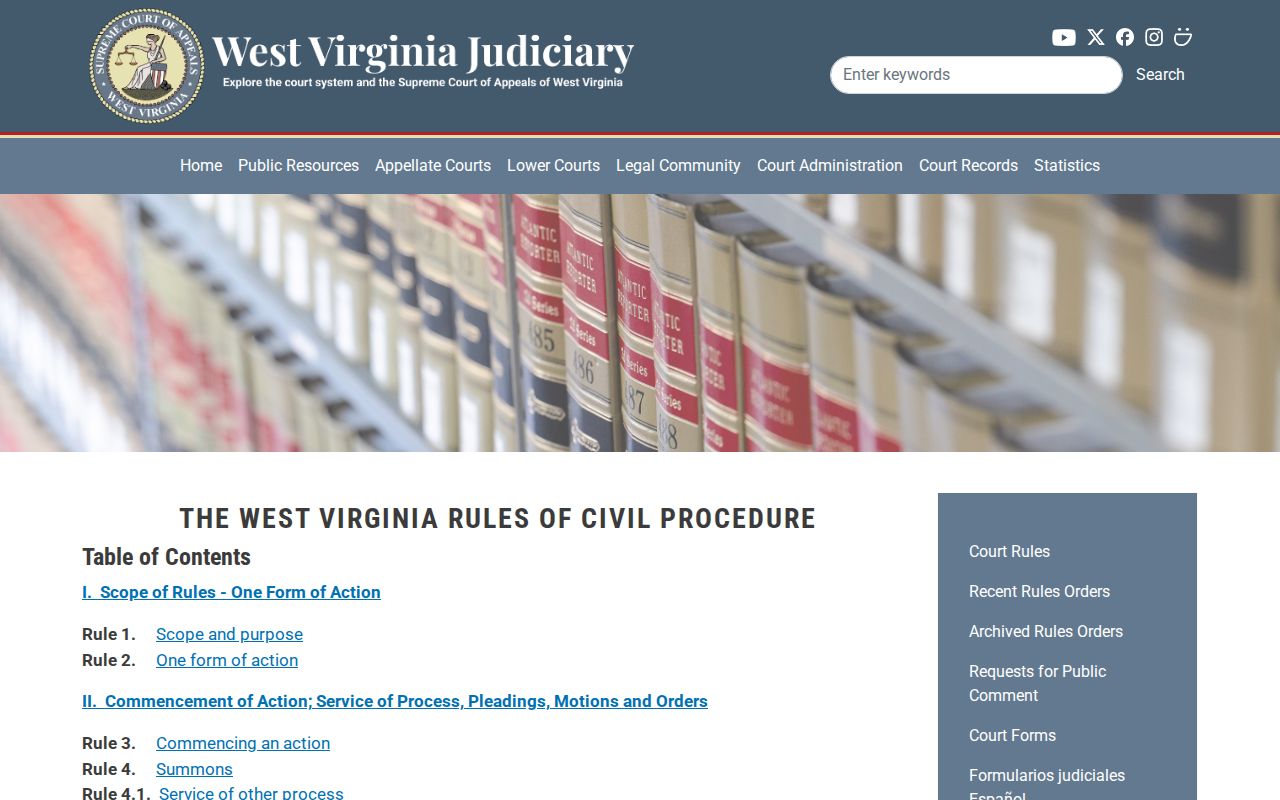
For the structure behind a Hardy County civil docket, the official West Virginia civil rules spell it out. They explain why service, appearances, orders, verdicts, and judgments each earn a separate entry.
Sequence tells the story. A filed complaint opens the record but proves no liability. Proof of service does not decide the claim either. A motion is only a request. The order that follows is the court's actual action. Read to the last public entry. Then pull the order or judgment itself when the exact wording matters.
- Service
- Formal delivery of required case papers.
- Appearance
- A party's formal participation in the case.
- Default judgment
- A judgment entered after a required response is not made, subject to governing rules.
- Order
- A written directive or decision entered by the court.
What Cases Fill the Civil Docket
Each Hardy court takes a different slice of civil work. Circuit Court handles actions above the Magistrate limit, along with equity cases and extraordinary writs. Family Court covers divorce, custody, paternity, support, and name changes. Magistrate Court takes the smaller claims. Some probate records never appear on a Circuit docket at all, because the County Clerk keeps them.
- Contract, debt, property, tort, and other Circuit civil actions
- Equity and extraordinary-writ matters within Circuit jurisdiction
- Divorce, custody, support, paternity, and other Family Court cases
- Magistrate civil disputes and small claims of $10,000 or less
- Probate or estate proceedings when court action is required
A civil label does not mean everything is public. Family Court pleadings and faces face tighter limits than ordinary civil filings. When you need one specific record, ask for the final order by name.
Hardy Small Claims by the Numbers
The 2024 annual report counts 368 small-claims filings in Hardy Magistrate Court. The same report lists one personal-safety petition and 36 domestic-violence emergency protective orders. It lists no temporary emergency protective orders. Read these as annual filing categories. They are not pending cases, outcomes, or counts of individual people.
Magistrate filing costs in West Virginia shift with the amount in dispute, and extra charges can apply. Call the Magistrate Clerk before filing or ordering papers. Dashboards may carry preliminary figures, so treat the annual report as the dated official source.
Hearings on the Civil Docket
A Hardy County civil docket lists motion hearings, pretrial events, trials, and other settings, and Rule 79 requires calendars of actions ready for trial. Remember that a listed date is only a date. A continuance can leave an old entry stale, so confirm with the clerk before you drive anywhere.
Hardy publishes no standalone public daily calendar. Check WVPASS or MCRS first, then call the Circuit Clerk for Circuit settings, the Magistrate Clerk for lower-court matters, or Family Court at 304-530-0267. The Supreme Court's current docket covers appellate cases only. For the fuller local process, see Court Schedule.
Hardy Civil Copies Need Planning
West Virginia Code sets $1 per page as the starting point for Circuit copies. Hardy County publishes no full certified-copy or postage schedule. WVPASS launch materials describe ordinary public downloads at 25 cents per page. A small card-processing fee also applies. A download is not the same as a certified copy, so plan accordingly.
When you request by mail, phone, fax, or in person, give the Hardy case number, name the exact pleading, order, or judgment, and say whether you want an ordinary or certified copy. Ask about the page estimate, certification charge, postage, payment methods, and turnaround before sending money. You can also inspect records at the Circuit Clerk's office during current hours. Access rules apply.
Copy checklist: case number, document name and date, ordinary or certified status, delivery method, fee confirmation, and return contact information.
Who Can See Civil Dockets
West Virginia Code §51-4-2 generally opens court records to inspection and copying unless special law applies. Sealing orders, protected identifiers, and rules for sensitive proceedings still limit that access. FOIA does not sweep those court-specific limits aside.
Key rules:
West Virginia Code § 51-4-2 provides the broad court-record inspection rule.
West Virginia Code § 48-1-303 makes domestic-relations orders public while keeping pleadings and exhibits confidential.
West Virginia Code § 48-27-312 restricts domestic-violence records and protects location information.
Not every civil docket is open. Juvenile cases, domestic-violence files, mental-hygiene matters, and expunged or sealed records may stay off limits, and protected identifiers are withheld too. When Hardy County returns no result, ask the Circuit Clerk which access rule covers that document instead of assuming the case never existed.
Hardy Family Orders Are Different
Family Court records work differently. You must ask for something precise. Public domestic-relations orders sit in the civil order books, but the rest of the file stays private. Pleadings, exhibits, financial papers, custody material, medical records, and discovery remain confidential during the case and after it ends, unless a rule or court order allows access. So the public decree is one slice of the record, not the whole thing. Search available Circuit and Family information through WVPASS first, then call the Circuit Clerk. Family Court sits at the Hardy courthouse in Room B-1, and its office number is 304-530-0267. Name the exact final order or decree you need. A narrow request lets the clerk apply the right access rule, and it keeps you from chasing papers the law keeps closed.